


Editorial Reviews

The Realtor by Dawn Banksy isn't just another memoir about overcoming adversity... it's a raw, deeply personal journey through the complicated layers of family, identity, and the pursuit of self-worth. What makes this book stand out isn't just the struggles as shared by the author, but the honesty with which she tells her story. There's no sugarcoating, no polished narrative designed to inspire without substance. Instead, what you'll find is something much rarer: truth.
From the very first chapters, Dawn Banksy draws you into her world, shaped by the challenges of growing up in a strict religious household under the influence of a narcissistic parent. She doesn't dramatize or over-explain these early experiences. She lets the weight of those moments speak for themselves. The feelings of powerlessness, the silence that comes with not being heard, and the constant pressure to conform... these themes are woven naturally into her storytelling.
What's especially striking is how she manages to balance vulnerability with resilience. Her experiences don't define her in the way you might expect. Instead of playing the victim, this story is a reminder that resilience often doesn't look like grand victories, it looks like getting up every day and trying again. There's something profoundly relatable about her journey, especially for readers who have faced their own struggles with self-esteem or family dynamics.
The heart of the book, however, lies in her determination to break generational cycles. As a mother, Dawn is painfully aware of the emotional inheritance she doesn't want to pass down. Her reflections on parenting aren't framed as advice but as lived experiences, mistakes, small victories, and quiet realizations. It's refreshing to read a story about parenting that doesn't pretend there's a perfect formula for success. Instead, Dawn's approach feels real: parenting with intention, learning to lead with empathy, and constantly striving to do better without pretending to have all the answers.
Equally compelling is how she connects her personal growth to her professional life. The metaphor of being a realtor—someone who helps others find their home—takes on deeper meaning as she rebuilds her own sense of self. There's a beautiful symmetry in how she helps clients find spaces where they feel safe while working to create her own emotional "home" from the ground up. Every closing deal becomes more than just a job; it's a reflection of her journey toward stability and independence.
One of the most powerful aspects of The Realtor is how Dawn Banksy has managed to capture the quiet moments of change. There are no grand epiphanies or life-altering revelations here, and that's what makes the book so relatable. Personal growth, as she describes it, happens slowly, through daily decisions, the courage to set boundaries, or the choice to prioritize self-care. This subtlety is where the book's real strength lies. It's not just about big transformations; it's about the smaller shifts that add up over time.
The writing itself is clean and accessible, yet emotionally charged in all the right places. She doesn't rely on flowery language or elaborate metaphors. Truthfully, the words feel like a conversation with someone who has lived through difficult truths and come out the other side with grace and clarity. This straightforward style allows the emotional depth of her story to shine without feeling forced or overly sentimental.
What stays with you long after finishing the book isn't just her story of survival but the insistence that healing is possible. There's no magic solution, no one-size-fits-all approach to breaking free from the patterns of your past. But through Dawn Banksy's journey, readers will find hope in persistence, in small victories, and in the decision to keep moving forward even when progress feels invisible.
The Realtor also offers an important reminder that success isn't always measured by career achievements or public recognition. Sometimes, the greatest success is simply learning to live authentically, to speak up when you were once silenced, and to build relationships rooted in love and understanding. Banksy's triumph isn't just in becoming a successful realtor or writing this book, it's in finding peace with her past while choosing a different future for herself and her children.
This book will resonate with anyone who has ever felt trapped by their upbringing or who struggles with the idea of "breaking the cycle." It's especially powerful for readers navigating the complex realities of parenting, personal growth, or rediscovering their voice after years of silence. Dawn Banksy doesn't offer easy answers, but she does offer something far more valuable: the reassurance that it's okay to struggle, that healing is messy, and that transformation is often found in the smallest, quietest acts of self-love.
In the end, The Realtor is not just a memoir. It's the hope of rewriting your own narrative. Dawn Banksy's story doesn't just inspire; it reminds us that no matter where we come from, we all have the power to build a home within ourselves.

Editorial Reviews

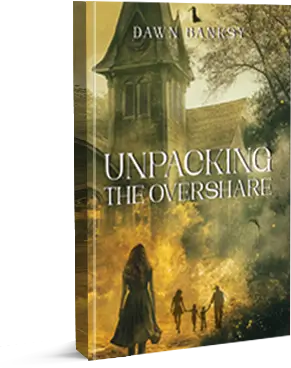
I didn't ease into Unpacking the Overshare, I fell into it... like someone cracking open a private journal, letting me read pages never intended to share. There was no warm-up, no gentle invitation. Just the sharp, unnerving feeling of honesty so pure it borders on uncomfortable. But it was impossible not to listen, because it's not meant to be comforting. It's raw, intelligent, and often devastating in its honesty. It tells the story of Beth, a woman, a mother, a wife, a Christian, a cancer patient, who, staring down the end of her life, untangles everything she never said aloud. This isn't a redemption arc, it's a reckoning. And it's extraordinary because of that. Beth narrates from the edge, sometimes literally her deathbed, sometimes just the emotional cliff of her own unraveling. She's not always likeable, and not always right. The way she tells her story, without self-pity, without agenda, but an unflinching emotional clarity, like a permission slip for the rest of us to stop pretending. There's a scene early in the book where Beth talks about being a good girl in her youth, how it was the only currency that ever got her praise. It hit me like a slap. The quiet rage of being raised to be obedient, gentle, easy. How that doesn't go away when you grow up. Just shapeshifts... into motherhood, marriage. Into silence. Beth's life is made of these silences; between her and her distant husband, her children. Even between her and her faith. The church looms large in her story, not as a villain, but as a system she both leaned on and was stifled by. What I appreciated most was how the author doesn't try to resolve Beth into something palatable. She makes bad choices, cheats, lashes out. She wants to be loved, admired, desired, and she's furious at the parts of herself that still need that. She's harsh on her children and hurts people. But she's also deeply self-aware. This book isn't for people looking for a heroine. It's for people looking for truth. And sometimes truth comes in ugly packages. One of the most powerful parts of the book is when Beth talks about her younger sister's death. It's devastating, not just because of the loss itself, but because of everything it churns up. The envy, the guilt, the unresolved grief. The way family myths are shattered in the wake of tragedy. It's one of the rare moments where Beth is fully vulnerable, not performing, not justifying, just... aching. The writing itself is stunning. It has this quiet rhythm to it, like someone thinking out loud but with an internal precision that only comes from years of reflection. There are moments where the prose is so sharp, so well observed, I had to stop and reread lines because they were so so true. One sentence in particular stayed with me: "She fed everyone but herself. Until hunger took another form." That line alone could be a thesis for half the women I know. There's also a layer of chronic illness threaded throughout the book. Beth is dying of cancer, yes, but her body has been betraying her for years. There's a real and painful honesty about how invisible illness gets dismissed, especially in women, and how people only start paying attention when you're on your way out. I haven't read many books that capture this particular silence, how a woman's pain is often translated as inconvenience. I think what gutted me most is that Beth doesn't just want to be forgiven. She wants to be seen. For the full, complicated, flawed person that she is. And that, more than anything, is what so many of us want... not approval or admiration. Just to be seen clearly, and held with some measure of grace. Reading Unpacking the Overshare felt like sitting in a confessional booth with someone who has nothing left to lose. And instead of judgment, what I felt was gratitude. This book will not tie things up for you. But it will sit with you, poking at things you thought you'd buried. It will make you wonder who you might be if you told the whole truth too. And maybe, that's the gift.